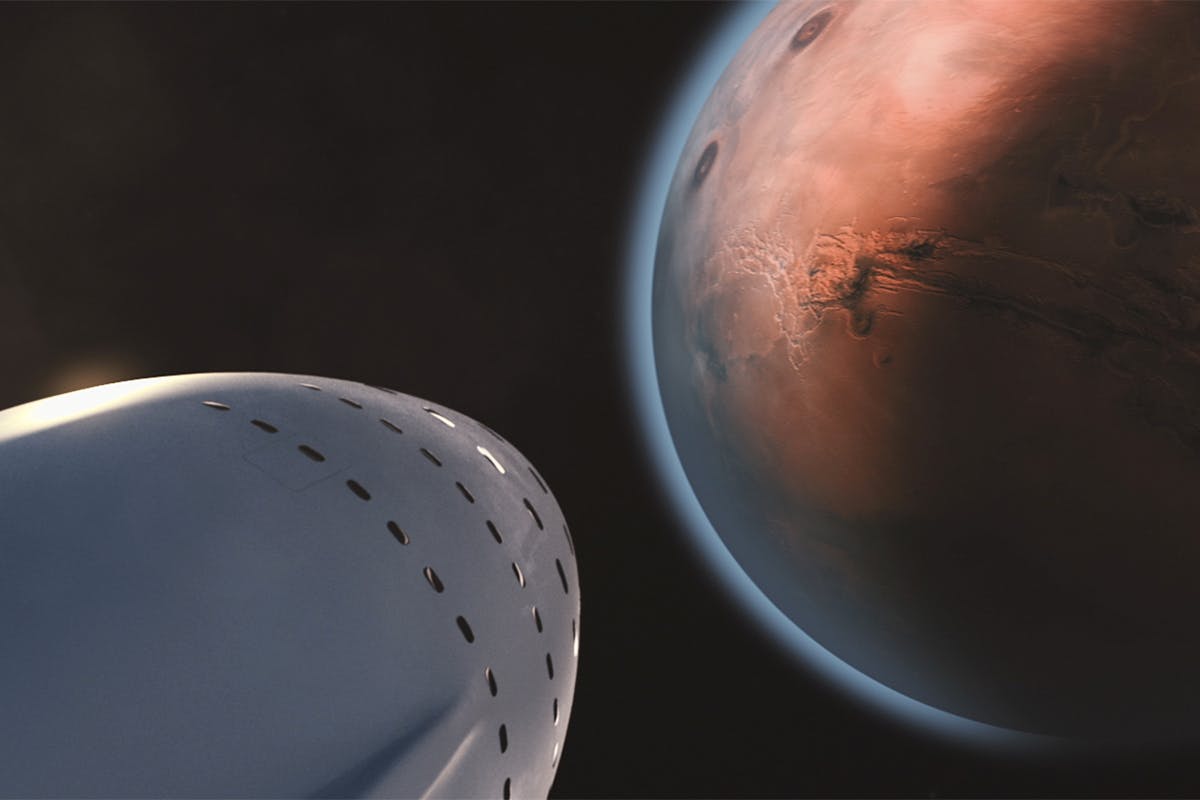
Migration has often been a way of survival for humanity, and today, in the face of climate and environmental crises, the possibility of expanding into space is becoming a reality. In 2005, Michael Griffin, then NASA administrator, stated that to survive in the long term, humanity cannot remain confined to one planet. However, despite technological advances, living on Mars presents great challenges, such as the long journey and hostile environmental conditions. In addition, establishing social rules and demographic evolution in space will be crucial to success.
Addressing the challenges of space exploration and potential settlement on other planets requires more than just technological and scientific considerations. It’s equally vital that humanities scholars – as geographers, historians, philosophers, sociologists – are actively involved. Their insights are crucial in comprehending and managing the environmental, cultural, moral, and social implications of these missions. Space is not just a technological frontier, but a new dimension for humanity. Life in space will demand solutions to physical and environmental challenges, but also the creation of new social structures, coexistence models, and governance paradigms.
Exogeography, a fundamental aspect of space exploration, delves into the morphology and habitability of extraterrestrial environments. It’s a key discipline in preparing for future human missions to other planets. This emerging branch of geography also has a significant geopolitical dimension, dealing with the management of space territories beyond national sovereignty. Population exogeography, another crucial area, focuses on the distribution and organization of human settlements in space. It studies the impact of new environmental conditions on mobility, population density, and resource accessibility.
The technical challenges faced in space have generated fundamental solutions for human progress. Space exploration has been an innovation laboratory with practical implications for our daily lives. Many of the technologies we take for granted today are derived from space research, such as telecommunications, GPS systems, and improvements in the medical and environmental fields. Observing the Earth from space offers a unique perspective that helps monitor and protect the planet, highlighting its uniqueness and the need to preserve it for the future. Space exploration, therefore, is not only an alternative to Earth but also a way to better understand our world’s fragility and beauty.